Google Analytics vs Plausible vs Simple Analytics: what's actually useful?
Plausible is the right call for most early-stage founders. Google Analytics makes sense if you run Google Ads or need advanced funnels. Simple Analytics wins on privacy and simplicity. All three share the same gap: they show you data but leave the interpretation entirely to you.
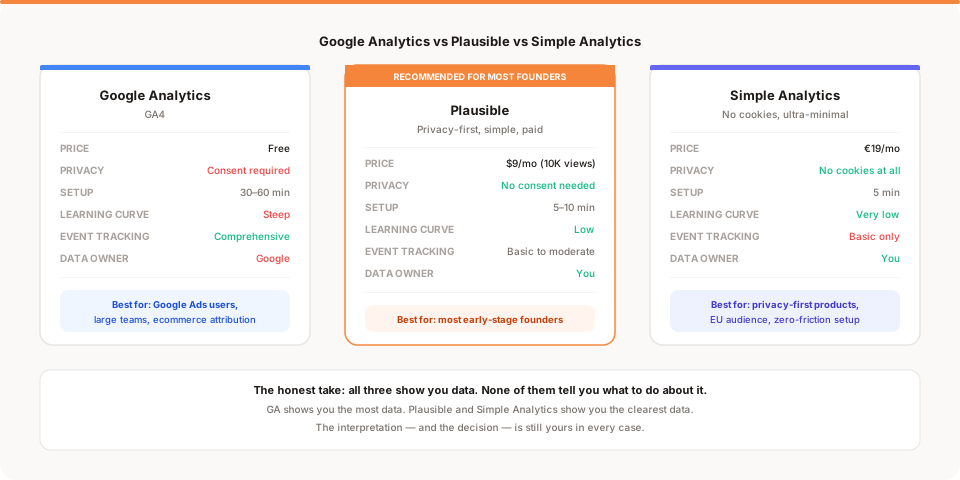
Most founders search for "Google Analytics vs Plausible" at some point, usually right after spending an afternoon trying to make sense of a GA4 report and wondering why it feels so hard.
There are good reasons to consider switching. There are also good reasons to stay. The answer depends less on which tool is "better" in the abstract and more on what you actually need from your analytics.
This is an honest breakdown of all three tools, including where each one falls short.
Why founders start looking for alternatives
Google Analytics was the default for years. It was free, comprehensive, and recommended everywhere. For a long time, there was no serious alternative worth considering.
Then two things happened.
First, Google migrated everyone from Universal Analytics to GA4. The transition was difficult. GA4 has a fundamentally different data model, a redesigned interface, and enough new terminology (sessions vs. events, engagement rate vs. bounce rate) that experienced GA users had to relearn a tool they thought they already knew. Many founders who were barely using their analytics tools suddenly had to start over with one that was even more complex.
Second, privacy law caught up. GDPR in Europe, CCPA in California, and similar legislation elsewhere created real compliance requirements around cookie-based tracking. Setting up GA correctly now involves consent management platforms, cookie banners, data processing agreements, and server-side configurations. For a solo founder, that is a substantial overhead.
Both of these things pushed founders toward alternatives. Plausible and Simple Analytics were ready to receive them.
Google Analytics: powerful, complex, and free
GA4 is the most capable of the three tools by a significant margin. It tracks events, sessions, user journeys, and cohorts. It integrates natively with Google Ads, making it the only real choice if attribution from paid campaigns matters to your business. It has a machine learning layer that can surface anomalies and predictions. It can handle enormous traffic volumes without hitting limits.
It is also the most difficult to use well.
The GA4 interface is non-obvious. Finding a simple metric like "how many people visited my pricing page this week compared to last week" requires navigating through reports that are not arranged in the order most founders think about their products. Building a custom funnel takes 20 minutes the first time. Understanding the difference between "users," "active users," "new users," and "sessions" in GA4 is genuinely confusing even for people who have used analytics tools for years.
The privacy setup is the other big issue. If you have EU visitors and you are running GA without a proper consent setup, you may be non-compliant. Getting this right requires either a Consent Management Platform (CMP) or careful configuration of IP anonymization, data retention, and data processing agreements. It is doable, but it adds real overhead for a tool you might be barely using.
Use Google Analytics if:
- You run Google Ads and need conversion attribution
- You have a data analyst or someone on the team who will actually use it
- You need advanced funnels, cohort analysis, or user journey tracking
- You have the time to configure it properly including the privacy layer
Avoid Google Analytics if:
- You want simple, fast answers to basic traffic questions
- You serve a primarily EU audience and do not want to manage a consent banner
- You check your analytics less than once a week (the tool will feel overwhelming every time)
- You are in your first six months and have fewer than 5,000 monthly visitors
Plausible: the right tool for most founders at the early stage
Plausible launched in 2019 as a direct response to GA's complexity. It is open source, privacy-first, EU-based, and designed to answer the questions most website owners actually have: how many people are visiting, where are they coming from, which pages are popular, and are goals being completed.
The dashboard fits on a single screen. Everything is visible at once. No reports to build, no filters to configure before you see useful data. You install a small script, and within an hour you are looking at real traffic with source attribution.
Privacy is built into the architecture rather than bolted on. Plausible does not use cookies, does not track individuals across sites, and does not sell or share your data. This means no consent banner is required in most EU jurisdictions. For a product with European users, this is a meaningful practical benefit.
The limitations are real but mostly only matter at a more advanced stage. Custom event tracking on Plausible requires a bit of configuration (a few lines of JavaScript for each event you want to track). Funnels are available on higher-tier plans. If you need the kind of detailed user journey analysis that GA provides, Plausible will eventually feel limited.
Pricing starts at $9 per month for up to 10,000 monthly pageviews. It scales with traffic. For most early-stage products, the base plan covers everything you need.
Use Plausible if:
- You want clean, fast answers without spending time learning the tool
- You have EU visitors and want to avoid cookie consent complexity
- You are getting started and need something that works in under 10 minutes
- You care about data ownership and privacy as a principle
Where Plausible falls short:
- Limited event tracking without custom setup
- No advanced cohort analysis or user journey mapping
- Not suitable as a replacement for GA if you run Google Ads
- Costs money, which matters if you have zero budget
Simple Analytics: minimum friction, maximum privacy
Simple Analytics takes the philosophy of Plausible even further. It is even simpler, even more privacy-protective (no cookies, no fingerprinting with a truly anonymous approach), and slightly more expensive at the entry level (€19 per month).
The interface is minimal by design. You see visitors, pageviews, top sources, top pages, referrers, and basic device/country data. That is most of what you need to understand whether your site is working.
Simple Analytics added an AI assistant feature that sets it apart from both GA and Plausible. You can type a plain-English question like "did signups from Twitter grow last month?" and get a direct answer without building a report. For founders who are not comfortable reading raw analytics dashboards, this is genuinely useful.
The main limitation is that Simple Analytics does not try to be comprehensive. There is no conversion tracking built in the same way as Plausible, no custom funnels, and no attribution model depth. If you need more than basic traffic data, you will hit the ceiling.
Use Simple Analytics if:
- Privacy is a core part of your product's positioning (running a privacy-first product or serving a privacy-conscious audience)
- You want the absolute minimum friction: install, forget, occasionally check
- The AI assistant appeals to you as a way to ask questions without reading charts
- You are in a jurisdiction where even Plausible's cookieless approach might need verification
Where Simple Analytics falls short:
- More expensive than Plausible for fewer features at the base tier
- No conversion funnels
- Limited custom event tracking
The honest comparison
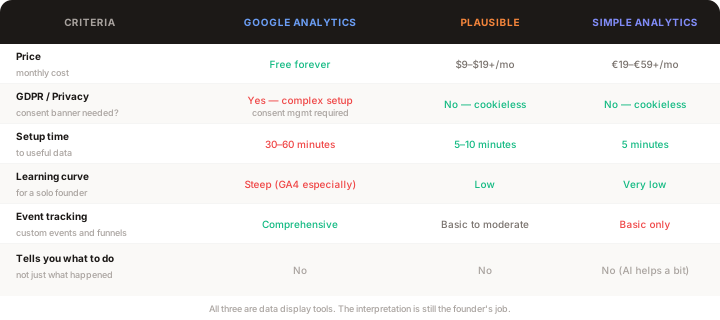
The table tells most of the story. But there is one row at the bottom that matters more than any of the others.
None of these tools tell you what to do.
GA shows you the most data. Plausible shows you the clearest data. Simple Analytics shows you the simplest data. But in every case, you look at the numbers and then figure out the next step yourself. The interpretation is on you.
This is the fundamental gap that applies to all three, and it is worth understanding before you pick a tool. Dashboards, even good ones, are a reading task you have to complete before you can make a decision. The tool shows you what happened. You determine why and what to do.
Plausible and Simple Analytics are genuinely better than GA for founders because they reduce the reading task significantly: the interface is cleaner, the numbers are clearer, and the time investment is lower. But neither one will tell you "your pricing page is losing 70% of visitors and here is what to check first."
If you want a framework for actually working through what your data means once you have a tool installed, the step-by-step guide to analyzing website data covers that process in detail.
How to choose based on your stage
The tool that is right for you depends on where you are, not which tool has the best feature list.
Pre-launch or just launched (under 1,000 monthly visitors): Pick Plausible or Simple Analytics and spend zero time on the decision. You need just enough data to know where your first visitors come from and whether any of them sign up. GA's complexity is a cost that does not pay off at this volume. Install Plausible, add a goal for signup completion, and check it once a week.
Early traction (1,000 to 20,000 monthly visitors): Plausible is probably your best call. You have enough traffic that the data is meaningful, and you are starting to care about which sources convert and which pages lose people. Plausible's filtering and goal tracking are adequate for this stage. The $9 to $19 monthly cost is a reasonable price for time saved relative to configuring and maintaining GA.
Running paid ads: Keep GA, or install it in addition to whatever else you use. The attribution integration with Google Ads is genuinely valuable and there is no good substitute. You can run Plausible alongside GA: use Plausible for your day-to-day traffic understanding and GA for ad campaign attribution.
EU-focused product or privacy-as-a-feature: Simple Analytics or Plausible, full stop. Do not make your users accept a cookie banner to access your marketing site when you have better options available.
Scaling beyond 50,000 monthly visitors: You will start to want funnels, cohorts, and event tracking depth. GA or Plausible on a higher plan. By this stage you will have a better sense of what questions you actually need to answer.
One thing worth knowing before you pick
Switching tools is not painful. The cost of being wrong is low. You can install Plausible today, run it for three months, and switch to something else without losing much. Analytics data is useful in real time but rarely historical in the way you might think. Most founders do not look back at data that is more than a few weeks old.
The worst choice is paralysis. Pick Plausible if you are uncertain. It costs little, installs fast, and respects your visitors' privacy without configuration. If you later discover you need GA's depth, you can add it then.
The questions you want your analytics to answer are straightforward: what to track and how to use what you find. The tool is just the mechanism for getting the numbers. The thinking about what those numbers mean is still yours to do, whatever tool you choose.
Keep reading
- Best Google Analytics alternatives for startups: a broader guide covering more options including Fathom, Umami, and PostHog
- Website analytics for startups: what to track and what to ignore: a guide to which metrics matter at the early stage
- How to analyze your website data: the step-by-step process for turning raw numbers into a decision
- Why dashboards fail solo founders: the deeper problem with all chart-first analytics tools
- Muro for founders: analytics that skips the dashboard and delivers insights directly