Traffic is up but conversions are down. What should you do?
When traffic rises and conversions drop, the problem is almost always traffic quality, not your landing page.
You check your analytics on Monday morning. Traffic is up 40% from last week. That should feel great.
But then you look at signups. They are flat. Maybe even down.
More people are visiting your site. Fewer of them are doing the thing you want them to do. The lines on the chart are moving in opposite directions, and you have no idea why.
This is one of the most common problems in product analytics, and it is also one of the most misunderstood. Most people react by changing their landing page, rewriting their CTA, or assuming something is broken. Usually, none of those are the real issue.
Here is how to figure out what is actually happening and what to do about it.
## The short answer
When traffic goes up and conversions go down, the most likely cause is traffic quality dilution. You are getting more visitors, but the new visitors are less likely to convert than your existing audience. Your product did not get worse. Your audience got broader.
The fix is not to change your product or your page. It is to understand where the new traffic is coming from and whether it is the right traffic.
Why this happens
There are four common reasons this pattern shows up. Usually it is one of these.
1. A viral moment brought the wrong audience
You posted something on X, Reddit, or Hacker News. It got traction. Thousands of people clicked through to your site. Most of them were curious, not interested. They looked around for 10 seconds and left.
This is the most common cause. Viral traffic is high volume and low intent. It makes your traffic chart look incredible and your conversion rate look terrible.
2. You changed something on your site without realizing the impact
A new landing page. A different hero section. A redesigned pricing page. Sometimes small changes have big effects on conversion, especially if you removed a CTA, changed the signup flow, or moved something important below the fold.
The tricky part is that these changes often happen at the same time as a traffic increase, so you assume the traffic is the problem when the real issue is the page.
3. A bot or referral spam spike inflated your numbers
Not all traffic is human. Bots, scrapers, and referral spam can inflate your visitor count without adding any real engagement. If your traffic jumped overnight with no obvious source, check whether the visitors are actually viewing pages or just hitting your URL.
4. Seasonality or timing
Some products see traffic patterns tied to the calendar. A Monday spike from a newsletter, a weekend dip, or a seasonal trend can create the illusion that something changed when really it is just the rhythm of your audience.
What most people do wrong
The instinct when conversions drop is to start fixing things. Rewrite the headline. Change the button color. Add a popup. Redesign the pricing page.
This is almost always premature.
If you change your page without understanding why conversions dropped, you might make things worse. You could optimize for the wrong audience, remove something that was working, or waste a week on a problem that would have resolved itself.
The first step is not to fix. It is to diagnose.
What to check instead
Here is a simple process you can follow. It takes about 15 minutes and will tell you whether you have a real problem or a temporary pattern.
Step 1: Break down traffic by source
Look at your visitors from the past 7 days, grouped by where they came from. Compare each source's volume and conversion rate to the previous period.
You are looking for one of two things:
- A new source that brought a lot of traffic but almost no conversions
- An existing source where conversion rate dropped even though volume stayed the same
If it is the first one, you have a traffic quality issue. If it is the second, something on your site probably changed.
Step 2: Check for page-level changes
Look at your top pages by bounce rate. Did any page's bounce rate spike? If your /pricing page went from 35% to 65% bounce rate, that is a signal that something on that page is causing friction.
Cross-reference this with your recent deploys or content changes. If the bounce spike started the same day you pushed a redesign, you have your answer.
This kind of page-level investigation is exactly what dashboards make harder than it needs to be. A good tool would surface this for you automatically.
Step 3: Look at the funnel, not just the top
Overall conversion rate can be misleading. Instead, look at each step:
- Visitor to signup page: Are people reaching the signup page at the same rate?
- Signup page to signup: Are people who reach the form completing it at the same rate?
- Signup to activation: Are new signups actually using the product?
If step 1 dropped but steps 2 and 3 are stable, the problem is traffic quality or navigation. If step 2 dropped, the signup page has an issue. If step 3 dropped, the product experience changed.
Step 4: Wait 48 hours before reacting
If the traffic spike came from a one-time event (a social post, a mention, a feature), the conversion rate will likely normalize within a few days as the spike fades. Check again in 48 hours. If the pattern persists, then act.
A real example
A solo founder launched a developer tool and posted a thread about it on X. The thread got 200 retweets. Traffic jumped from 300 to 1,800 visitors in one day. But signups only went from 12 to 15.
The conversion rate dropped from 4% to 0.8%.
Panic set in. The founder started rewriting the landing page.
But here is what the data actually showed:
- Organic and direct traffic still converted at 4.2%
- Twitter traffic converted at 0.3%
- The landing page was fine for the existing audience
- The Twitter audience was mostly other developers browsing, not potential customers
The right response was not to change the landing page. It was to understand that Twitter traffic is low-intent for this product and focus on growing organic and direct traffic instead.
The founder stopped rewriting and started writing SEO content. Within a month, organic traffic doubled and the conversion rate held steady.
The framework: what happened, why, what to do
Every time you see a metric move in an unexpected direction, ask three questions in order:
1. What happened? Traffic increased 40%. Signups stayed flat. Conversion rate dropped from 3.2% to 1.9%.
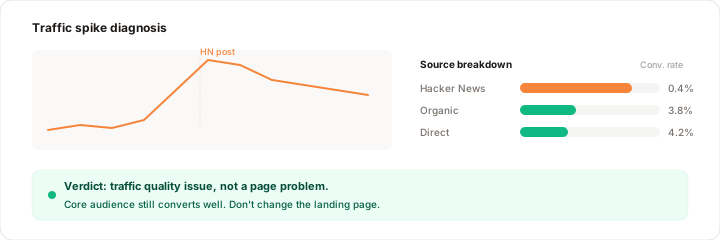
2. Why did it happen? A Hacker News post drove 2,000 new visitors. Those visitors had a 0.4% conversion rate vs 3.8% for organic traffic. The landing page and signup flow are unchanged.
3. What should I do? Nothing to the landing page. The existing audience still converts well. Consider writing content that targets the Hacker News audience more specifically, or accept that this traffic source is awareness, not conversion.
This is the difference between data and insight. The data says "conversion rate dropped." The insight says "new traffic is diluting your rate, but your core audience is fine."
Most analytics tools give you the data. Very few give you the insight. And almost none tell you what to do about it.
When the problem is real
Sometimes the traffic-up-conversions-down pattern is not just dilution. Here are the signs that something genuinely broke:
- Your existing traffic sources also show lower conversion rates
- The drop persists for more than a week after traffic normalizes
- Your signup or checkout flow has a new friction point (error, slow load, broken form)
- You recently changed pricing, copy, or layout on a high-traffic page
If any of these are true, the fix is specific: identify the page or step where the drop happens and address that specific issue. Do not change everything at once. For a full diagnostic walkthrough, read why your conversion rate is low and how to fix it.
How to read the source quality breakdown
Once you have broken down conversion by source, you will typically see a pattern like this:
| Source | Visitors | Signups | Rate | | --- | --- | --- | --- | | Organic search | 180 | 7 | 3.9% | | Direct | 120 | 5 | 4.2% | | Twitter | 1,400 | 4 | 0.3% | | Product Hunt | 900 | 3 | 0.3% |
Total: 2,600 visitors, 19 signups, 0.7% overall rate.
Looking at just the total, this looks terrible. But organic and direct are converting at 4%. The product and the page are both fine. What happened is that 2,300 new visitors from Twitter and Product Hunt pulled the overall rate down to 0.7%.
The decision here is not to redesign anything. The decision is:
- Stop spending energy on Twitter as a conversion channel (it may still be worth it for awareness)
- Invest in growing organic search, which already converts well
- Make a note that Product Hunt traffic is awareness, not acquisition
That is a meaningful strategic insight from one analysis session.
How long to wait before acting
One of the most valuable habits in analytics is knowing when to wait.
If traffic spiked yesterday because of a social post, do not make any product or page decisions for at least 48 hours. The spike will fade. Traffic will return toward baseline. Your conversion rate will normalize.
The meaningful question is: what is the conversion rate after the spike fades?
If it goes back to where it was before the spike, the spike was a burst event and your product is unchanged. If it stays lower than before, something else changed and it is worth investigating.
The rule of thumb: wait until you have 200 to 300 visitors at the new steady state before making any decisions based on conversion rate. Below that, the numbers are too noisy.
When the problem is not traffic quality
Occasionally, traffic is up and conversions are genuinely down because something broke. Here is how to tell the difference:
Conversion rate dropped across all sources. If organic, direct, and social all dropped at the same time, traffic quality is not the cause. Something changed on your site. Check for recent deploys, A/B test variants, or pricing changes.
The drop persisted past the traffic spike. If traffic returned to normal but conversion stayed low, look at your signup flow. Something in the path from landing page to signed up is now harder than it was.
There is a spike in bounce rate on a specific page. If one page suddenly has a much higher bounce rate, check for a broken form, a missing CTA, or a layout that changed. These are often caused by code changes that had unintended side effects.
Mobile conversion is lower than before. If a deploy changed something about the mobile layout or signup form, mobile conversion drops while desktop stays stable. Check device breakdown in your analytics.
For a full guide to diagnosing why conversion is low, why your conversion rate is low and how to fix it covers each cause in detail.
A calmer approach to analytics
The pattern of traffic up, conversions down is stressful because it feels like something is wrong. But most of the time, it is a sign that something is working. You got more attention. Now you need to understand what kind of attention it was.
The best response is not to panic and optimize. It is to ask the right questions, check the right data, and make one small change based on what you actually find.
That is what good analytics should help you do. Not just show you the chart. Tell you what it means. And suggest what to try next.
For a deeper framework on turning data into decisions, read how to act on your website data. If you are in your first week after launch, start with what to track in your first week.