How to improve your onboarding experience (without overcomplicating it)
Good onboarding has one job: get users to their first meaningful result as fast as possible. Everything else, profile setup, team invites, feature tours, can happen after that moment. Most products fail at onboarding because they put overhead before value.
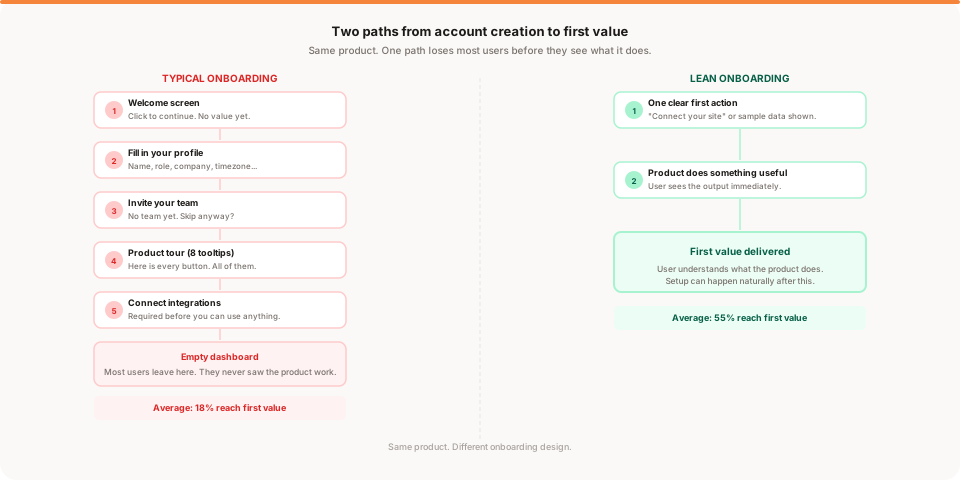
Most products lose the majority of new users before those users ever see what the product actually does.
Not because the product is bad. Not because the visitors were the wrong audience. But because the path from "just signed up" to "understood why this product exists" was long enough, confusing enough, or empty enough that most people gave up before reaching the end.
This is an onboarding problem. And it is one of the most impactful things you can improve, because it sits between all the work you did to get a user to sign up and all the retention and revenue that depends on those users becoming active.
Signup, onboarding, and activation are three different things
These three terms often get conflated, and confusing them leads to misdiagnosed problems.
Signup is the process of creating an account: filling out a form, verifying an email, completing whatever steps are required to get credentials. Why users don't complete signup is its own topic with its own fixes. That post covers everything that happens before the user has an account.
Onboarding is the designed experience that guides a new user from having an account to experiencing the product's core value for the first time. It is the in-product journey. It is what this article is about.
Activation is the outcome: the specific moment when a user experiences the product's core value. Defining and measuring activation is covered in depth separately. Activation is what you are trying to produce through onboarding.
The relationship between them is simple: good onboarding leads reliably to activation. Most onboarding problems are not about missing features. They are about a path that is too long, too confusing, or too front-loaded with overhead before the user sees anything useful.
Why onboarding gets overcomplicated
The most common version of bad onboarding looks like this: welcome screen, profile setup, team invite, feature tour, integration configuration, "you're all set!" screen. Six steps before the user has done anything meaningful.
This happens for understandable reasons.
Founders build these steps because each one seems reasonable in isolation. The profile step is needed eventually. The team invite is useful if they want to collaborate. The feature tour is helpful if they don't know where to start. Each decision feels justified.
But the combined effect is a gauntlet of overhead that most users never finish. They get tired, confused, or distracted before reaching the moment that would have made them want to use the product.
The deeper problem is a framing issue. Most overcomplicated onboarding was designed from the product's perspective: "here is everything the product can do, here is what we need from you to set it up." What it should be designed from is the user's perspective: "here is the one thing you can do right now that will show you why this product is worth your time."
The only job onboarding has
Onboarding has one job: get the user to their first meaningful result as fast as possible.
Not teach them the product. Not collect their preferences. Not demonstrate all the features. Get them to their first result.
Once a user has experienced value, everything else becomes much easier. They are willing to fill in profile information because they now have a reason to care about the product. They are willing to configure integrations because they understand what output those integrations will produce. They are willing to read documentation because they want to get more of the thing they just experienced.
Before first value, you are asking a stranger to do work for a promise. After first value, you are asking a user to invest in something they have already seen work.
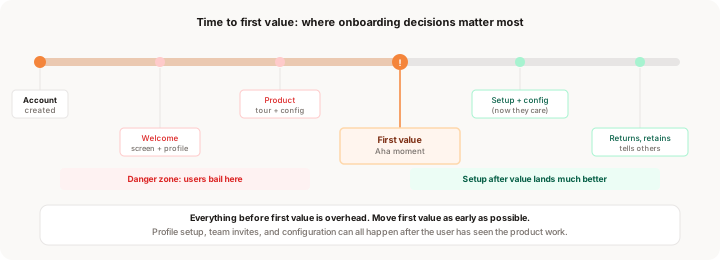
This reframing changes how you evaluate every onboarding step. The question is not "is this step useful?" The question is: "does this step help the user reach their first meaningful result, or is it overhead I can move to after that moment?"
The most common onboarding problems
1. The welcome screen that does nothing
A modal or screen that says "Welcome to ProductName! Here is a quick overview." with a generic "Get started" button.
This step teaches the user nothing. It adds a click. And critically, it delays the moment the product does something for them. Welcome screens are almost universally removable without any negative effect on activation.
If you feel the product needs an introduction, replace the welcome screen with a single directive: "Let's do the one thing this product is for. Click here to start." That is an introduction and a first step at the same time.
2. Required setup before the product is usable
"Before you can use the dashboard, please connect at least one data source."
For some products, this is unavoidable. A tool that analyzes your data cannot show you insights before you have data. But many products impose setup requirements that are not actually necessary for the first experience.
The test: can you show the user what the product output looks like before they complete the setup? If yes, do that. Sample data, demo content, and pre-populated examples let users experience the product before investing in configuration.
A user who has seen the product work is 3x to 5x more likely to complete setup than one who has not. Showing value first and asking for setup second is not a workaround. It is better design.
3. A feature tour instead of a doing experience
Feature tours that click through the interface explaining each button were popular a decade ago. They are now widely understood to reduce activation.
The problem is that explaining a feature and using a feature are completely different experiences. "This button creates a project. This section shows your timeline. This icon opens settings." teaches the user almost nothing about whether this product is for them. It does not produce value. It creates obligation (watching the tour) without reward (experiencing something useful).
If you want to guide users to their first action, prompt them to do the action. Not "this is where you create a project" but "create your first project now." One tooltip, one button, one result. The doing is the onboarding.
4. An empty dashboard with no direction
This is one of the highest-impact activation killers for data products and productivity tools. The user completes signup, lands in the product, and sees an empty dashboard. Blank charts. Placeholder text. A screen that looks like a waiting room.
They have no idea what to do. The product has not done anything for them. So they leave.
The fix is to never show a completely empty state. Two good options:
Sample data. Pre-populate the dashboard with representative fictional data. The user immediately sees what the product looks like when it is working. They understand what they are setting up. Analytics tools, CRM platforms, and project management apps all benefit from this approach.
A single directive. If sample data is not appropriate for your product, replace the empty dashboard with one screen that says "Your dashboard will show [specific output]. To get there, do [one specific action] now." Clear next step, explains what they will get, removes the "now what?" paralysis.
5. Too many steps before the aha moment
Every step in your onboarding flow that sits before the user's first experience of value is a potential exit point. Users who are curious but not yet committed will drop off at each one.
The math is brutal. If each step retains 80% of users, a 6-step onboarding reaches first value with only 26% of users who started it. A 2-step onboarding reaches first value with 64%. That gap is not a minor optimization. It is the difference between building an active user base and filling a leaky bucket.
Count the steps between account creation and your activation event. Ask for each one: is this required to reach first value? If the answer is no, move it after the aha moment or remove it entirely.
How to audit your own onboarding
Before changing anything, diagnose where users are actually dropping off.
Walk it yourself. Create a new account (use an incognito window or a fresh email) and go through onboarding as if you have never seen your product before. Time yourself. Note every moment where you are confused, uncertain about what to do next, or unsure whether the effort is worth continuing. This single exercise reveals most of the problems.
Measure step completion. If you have any event tracking, check how many users complete each step. If 300 users reach step 2 but only 90 reach step 3, step 3 is the bottleneck. Fix that step before anything else. For a framework on finding these bottlenecks across your full funnel, where users drop off on your website covers the full analysis.
Check time to activation. How long after account creation do users typically complete the activation event? Under 10 minutes is strong for most products. Over 30 minutes is a signal that the path to first value is too long. Over an hour means most users who "activate" are exceptional outliers, not representative of your onboarding working. For benchmarks on what fast versus slow looks like and a full framework for measuring this number, time to first value covers the metric in depth.
Look at activation by cohort. Do users who signed up from organic search activate at a higher rate than users who signed up from a Product Hunt spike? If yes, the organic users had clearer intent, which means the onboarding is demanding more than casual visitors will invest. That is a signal to simplify.
What to fix first
Once you know where users are dropping off, prioritize fixes in this order.
Earliest drop-off first. If most users leave at step 2, fixing steps 3 through 6 is irrelevant. Users are not reaching them. The rule: fix the earliest broken step before any later one.
Move setup after first value. Identify every step in your onboarding that is not directly required to produce the first valuable output. Move all of them to after the aha moment. This is usually the single highest-impact change.
Replace empty states. If your product shows empty dashboards or blank screens before the user has done anything, add sample data or a clear first directive. This is often a one-day fix.
Shorten or remove the feature tour. If you have a tooltip-based tour with more than 3 steps, cut it or replace it with a single prompt to do the first action.
The connection to retention
Users who activate retain at significantly higher rates than users who sign up but never reach first value. The two groups behave almost like different cohorts. Improving onboarding is not just about getting users to the product. It is about growing the group of users who are likely to stay.
Early retention is almost always an activation problem in disguise. If your day-7 retention is low, improving your onboarding to increase activation will typically move retention as a result. You do not need to solve both separately.
Keep reading
- Why users don't complete signup: the six reasons users leave before they even have an account — the step before onboarding
- What is user activation: how to define and measure the event that marks successful onboarding
- Why users don't come back: how early retention connects to whether onboarding worked
- Where users drop off on your website: funnel analysis framework for finding the specific step where most users leave
- Muro for founders: analytics that shows onboarding drop-off and activation rates automatically