Time to first value: why it matters (and how to improve it)
Time to first value is the single number that predicts whether a new user will stay or leave. Most products let this number climb too high by accident. The fix is almost always removing steps, not adding features.
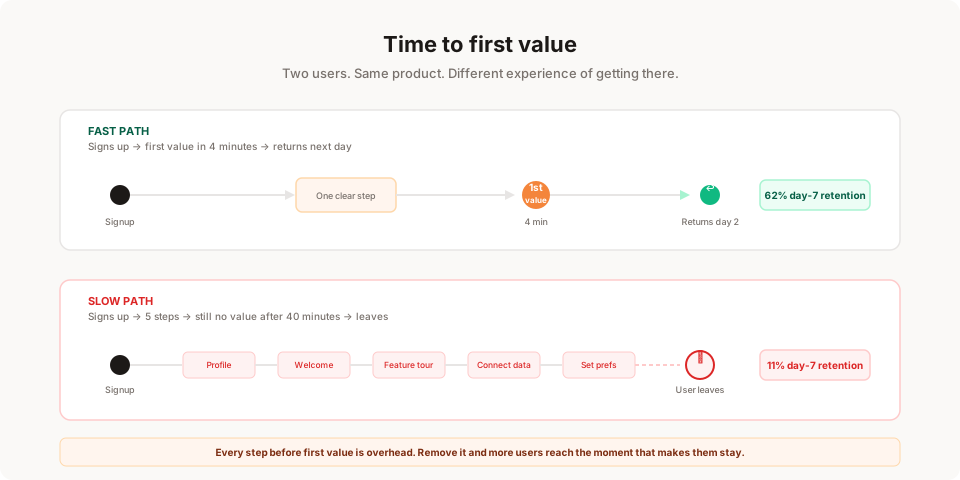
Someone signed up for your product. They had good intent. They found you, they clicked the button, they handed over their email. They were in.
But nothing meaningful happened. They saw a setup screen. Or a blank dashboard. Or an onboarding wizard that asked about their team size, their role, their preferences, and their primary use case before showing them anything the product actually does.
Most of them left.
Not because the product was bad. Not because they lost interest. Because the gap between "just signed up" and "understood why this product is worth my time" was too wide, and attention ran out before they crossed it.
That gap has a name: time to first value.
What time to first value actually means
Time to first value (TTFV) is the duration between a user creating an account and the moment they experience your product's core output for the first time.
It is a time-based metric. That is the key distinction. Activation rate tells you what percentage of users reach the first value moment. TTFV tells you how long it takes the ones who get there.
Both metrics matter, but they diagnose different problems. A product with a 40% activation rate and a median TTFV of 4 minutes is in a different situation than one with a 40% activation rate and a median TTFV of 40 minutes. The first product is only converting 4 in 10 users, but those who do convert are getting there fast. The second is forcing even its most committed users to work hard before they see anything.
What "first value" looks like varies by product type:
- Analytics tool: receiving the first traffic summary or insight
- Project management app: seeing a populated task board with real data
- Email marketing tool: sending their first campaign or seeing a preview of one
- CRM: viewing a populated contact record or logging the first interaction
- Landing page builder: seeing their first page render live
- Note-taking app: creating a note and seeing it saved in an organized structure
The pattern is the same across all categories. First value is the first moment the user goes from "this product does X" to "I can see what X actually looks like when it works for me."
Why TTFV matters more than most metrics
TTFV is a leading indicator. It predicts what will happen with retention before retention data has had time to accumulate.
The mechanism is simple. A new user brings a fixed window of attention to their first visit. That window might be 5 minutes for a casual signup or 20 minutes for someone with strong intent. The window closes when they get distracted, switch tabs, get pulled into another task, or simply run out of patience.
If the user reaches first value before the window closes, they leave with a real impression of the product doing something useful. They come back. If the window closes before first value, they leave with an impression of the setup process. They almost never come back.
This is why products that have a solid concept but weak early retention so often have a TTFV problem at the root. Users agree with the pitch. They just never experience the product.
It is also why measuring activation rate alone is not enough. A user who activated 45 minutes after signing up activated under different conditions than one who activated in 3 minutes. The first user had to push through multiple friction points. They are the exception. The second user had a smooth path. Improve that path and more people take it.
How long is too long
There is no universal number, but these ranges are a useful starting point for most web-based SaaS tools and products:
Under 5 minutes: Strong. The user experiences value in a single focused interaction. They have almost certainly seen what the product does before their attention drifted elsewhere.
5 to 15 minutes: Acceptable. Some setup or configuration is required, but the user can reach value in one session without losing momentum.
15 to 30 minutes: Risky. Many users will not invest half an hour before seeing any output. You are increasingly relying on high-intent visitors and losing everyone more casual.
Over 30 minutes: A significant problem for most products. The users who activate are exceptional outliers, not a representative sample of your signups.
One important caveat: some products cannot avoid a longer TTFV because the output depends on real data collection. An analytics tool cannot show you a traffic insight until there has been real traffic. A monitoring tool cannot send an alert until something happens. These products need a different strategy, covered below.

Five reasons TTFV gets too high
1. Required setup before the product is usable
The most common cause. The product forces users through account configuration, team setup, integration connection, or preference collection before showing any output at all.
Each of these steps makes sense in isolation. But the sequence matters as much as the steps themselves. When setup comes before any glimpse of the product working, many users will not complete it.
The question to ask for every pre-value step: can I show the user what the output looks like before asking for this? If yes, show it first. Use sample data. Build a demo mode. Let users see what the product does before asking them to invest in setting it up.
2. No clear first action
The user is in the product. They have an account. And they do not know what to do.
No clear prompt. Multiple options with no obvious starting point. An interface designed for power users who already understand the product, not for someone who joined five minutes ago.
When users do not know what to do next, they explore. Exploration is inefficient. It burns time and attention without reliably leading to value. The user might find the right action eventually, or they might give up after a few dead ends.
The fix is a single directive on first load: "Do this one thing to see the product work." One clear action. One described outcome. No competing choices until after the user has experienced value once.
3. Too many steps before value
Every step between account creation and first value is a potential exit. The compounding effect is steep.
If each step retains 80% of users, a 6-step path to first value delivers only 26% of users to the end. A 2-step path delivers 64%. That 38-point gap is not a minor optimization. It is the difference between most of your users reaching the product versus most of them leaving before they get there.
Count the steps in your path to first value right now. For each one, ask whether it is strictly required to produce the first meaningful output. Move everything optional to after the aha moment.
4. Long wait times for async-output products
Analytics tools, email platforms, monitoring products, and similar categories face a specific version of this problem. The user signs up, completes setup, and then waits. The product cannot show them real output until real data has been collected.
This kind of TTFV cannot be fully engineered away. But it can be managed.
The most effective approach is sample data. Show users what their dashboard will look like using fictional but representative data. They see the product working immediately. They understand what they are setting up. The wait for real data feels purposeful rather than empty.
A second option: shorten the window for the first real output. If the user installs your tracking code today, can you send them a summary email when their first data arrives, 2 hours after the fact, rather than waiting for them to check back? That notification reaches them while the product is still in their head, not three days later when they have forgotten they signed up.
5. UX friction that accumulates
Sometimes TTFV is high not because the path is long but because the path is confusing. Forms that are hard to complete on mobile. Error states that do not explain what went wrong. A button that is not obviously clickable. A page that requires scrolling to find the key action.
This kind of friction does not show up as a drop-off at one specific step. It slows users down across many small moments. The cumulative effect can turn a 3-minute path into a 20-minute one.
The fix: complete your own signup-to-value flow on desktop and on mobile, and time it. Note every moment of hesitation. Each one is friction. Some will be small. Together they can represent the difference between a user who stays and one who drifts away.
How to measure your TTFV
You need two timestamps for each user:
- Account creation time
- Activation event time (when they completed the first value action you have defined)
Calculate the median TTFV from all users who activated. Use median rather than average. A small number of users who return days or weeks later will skew the average significantly, making your path look slower than it actually is for most people.
Also track the distribution: what percentage of activating users reached first value within 5 minutes? Within 15 minutes? Within 24 hours? The shape of this distribution tells you more than a single number. If 80% of activating users get there within 8 minutes, your path is fast and the opportunity is in activation rate. If the median is 35 minutes with a long tail, the path itself is the problem.
Most analytics tools or a basic database query can surface this data. If your current analytics setup does not show it, calculate it manually once. Knowing your current TTFV is more valuable than most of the charts your dashboard is probably showing you.
How to reduce it
Once you know where the time is going, the reductions are almost always structural.
Move setup overhead to after first value. This is the single highest-impact change for most products. Anything between account creation and first value that is not strictly required to produce that first output should happen after it. Profile configuration, team invites, integration setup, preference collection: move all of it. The full onboarding design framework covers how to redesign this sequence in practice.
Give users one clear starting action. Replace the empty dashboard or the multi-option home screen with a single prompt. The user should never have to figure out where to begin. "Create your first project" with one button beats a well-designed interface with six choices.
Use sample data to bridge async wait times. For products that depend on real data collection, pre-populate with representative fictional content. Show the user what the product looks like when it is working. They can replace sample data with real data once it arrives, but they have seen the product in action before they invest in setting it up.
Fix the mobile path specifically. If a significant portion of your signups come from mobile (and for most products, they do), your TTFV for mobile users is probably significantly higher than for desktop. Run through the full flow on a phone. Address every point where you slow down.
Send a trigger when first output is ready. For async products, the email or notification that says "your first data is ready" is one of the most effective TTFV interventions available. It brings users back at the exact moment the product has something to show them.
How TTFV connects to retention and growth
TTFV and retention are tightly linked, and the mechanism runs in one direction.
Users who reach first value quickly form a mental model of what the product does for them. That mental model is what brings them back. They come back to see more of the thing they already experienced. Users who sign up but never clearly experience the core output have no model. There is nothing to return to.
Early retention problems are almost always an activation problem. And activation problems usually have a TTFV problem underneath them. It is not just that users are failing to activate. It is that the path to activation is long enough that most users run out of time or patience before they complete it.
When you reduce TTFV, you increase the share of new users who form a real impression of the product before their attention closes. Those users return. Some of them upgrade. Some of them tell other people. The compounding effect from a faster path to first value shows up across the entire growth loop.
A simple audit for this week
If you have not measured your TTFV before, start here:
- Define your activation event clearly. What specific action represents a user receiving the product's core value for the first time?
- Pick 20 to 30 recent signups who activated. Calculate the time between account creation and the activation event for each.
- Find the median. Note the fastest and slowest in the sample.
- Walk through the signup-to-value flow yourself. On desktop. On mobile. Time it.
- List every step before the activation event. Mark each one: required to reach first value, or can be moved after.
- Move at least one step from the second list to after the aha moment. Ship it. Measure again in two weeks.
The products that improve fastest at this tend to treat TTFV the same way they treat activation rate: as a tracked metric that gets reviewed regularly, not a vague feeling that onboarding might be too long. The gap between knowing your TTFV and not knowing it is the gap between making deliberate changes and guessing.
Keep reading
- What is user activation: how to define and measure the activation event that marks the end of the TTFV window
- How to improve your onboarding experience: the design framework for shortening the path to first value
- Why users don't come back: how early retention connects to whether first value was reached quickly enough
- Muro for founders: see how Muro surfaces time-to-activation data without a complex analytics setup