What is user activation? (And how to measure it properly)
Activation measures whether users experienced your product's core value. It is the best predictor of retention and the most important metric most founders ignore.
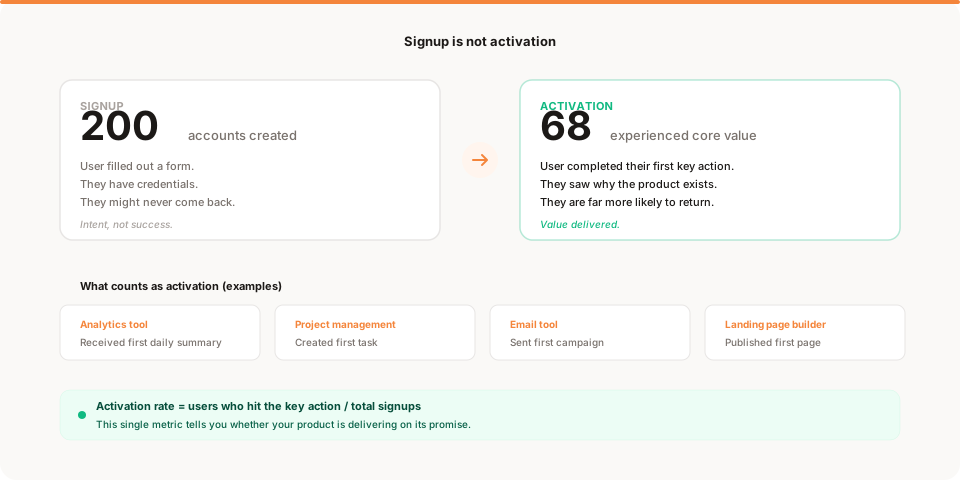
You launched your product two months ago. You have 200 signups. That sounds good.
But when you look at actual usage, only 68 of those people ever did anything meaningful in the product. The other 132 created an account, looked around, and left.
Your signup number says 200. Your real user count is 68. That is a 34% activation rate.
Most founders do not track this number. They track signups. They track traffic. They track conversion rate. But they skip the one metric that tells you whether your product is actually working: activation.
What activation actually means
Activation is the moment a user experiences your product's core value for the first time.
It is not the same as signup. Signup is creating credentials. Activation is using the product.
It is not the same as a pageview. Seeing the dashboard is not activation. Doing something meaningful on the dashboard is.
The specific action depends on your product:
- Analytics tool: received their first daily summary or insight
- Project management app: created their first task or project
- Email marketing tool: sent their first campaign
- Landing page builder: published their first page
- Note-taking app: created their first note with real content
- CRM: added their first contact
The pattern is the same across all products. Activation is the first moment where the user gets value, not just access.
Why activation matters more than signup count
Here is why this metric changes how you think about your product.
Activated users retain. Non-activated users do not.
If you compare retention curves for activated users versus non-activated users, the difference is stark. Activated users return at 3x to 10x the rate of users who signed up but never completed the key action.
This means your retention problem is not a retention problem. It is an activation problem. If you improve activation from 34% to 55%, your week-2 retention might double without changing anything else about the product.
Signup count is vanity without activation
200 signups sounds like growth. But if only 68 activated, you do not have 200 users. You have 68 users and 132 abandoned accounts.
Tracking signups without tracking activation is like tracking visitors without tracking conversions. The first number feels good. The second number tells you the truth.
Activation is the bridge between acquisition and retention
In the simplest growth model, the funnel is: traffic, signup, activation, retention, revenue. Most founders focus on traffic and signup. They spend weeks improving conversion rate and growing traffic.
But if activation is broken, all of that effort leaks out. You pour users into the top of the funnel and they drain out before reaching retention.
Fixing activation is usually the highest-leverage growth work you can do.
How to define activation for your product
This is the hardest part. Choosing the wrong activation event leads to misleading data. Choosing the right one gives you a clear signal about product health.
The "aha moment" test
Your activation event should be the action that creates the "aha moment" for the user. The moment they understand why the product exists and why it is useful for them.
For Slack, it is sending messages in a channel. For Dropbox, it is saving a file to a shared folder. For an analytics tool, it is seeing the first insight or summary.
Ask yourself: what is the one thing a user does that makes them go "oh, I get it now"? That is your activation event.
The retention correlation test
If you already have some data, check whether users who completed a specific action retain better than those who did not.
Look at two groups:
- Users who completed action X in their first session
- Users who did not complete action X
If the first group retains at 40% after 7 days and the second retains at 8%, action X is strongly correlated with retention. That is a good activation metric.
Common mistakes in choosing activation events
Too broad: "User logged in" is not activation. Logging in is access, not value. If every user who creates an account also "logs in," the metric is useless.
Too deep: "User completed all 12 onboarding steps" is too late. By step 12, most users are gone. Activation should happen early, ideally in the first session.
Too easy: "User viewed the dashboard" is too passive. Viewing is not doing. The user should have taken an action that creates or demonstrates value.
Too hard: "User invited 5 team members and ran 3 reports" is too demanding. If only 5% of users reach this bar, you are measuring power users, not activation.
The sweet spot is a meaningful action that most engaged users complete in their first or second session.
How to measure activation
Once you have defined your activation event, measurement is straightforward.
The basic formula
Activation rate = users who completed the activation event / total signups (in the same time period)
If 200 users signed up this month and 68 completed the activation event, your activation rate is 34%.
What to track
You need two numbers:
- Total new signups in a given period
- How many of those signups completed the activation event within a defined window (usually 24 hours, 3 days, or 7 days)
The time window matters. A 24-hour activation window is stricter and gives you faster feedback. A 7-day window is more forgiving and captures users who come back later.
Start with a 7-day window. Tighten it to 24 or 48 hours once you have more data and want to iterate faster. Within that window, the specific time it takes a user to reach the activation event also matters as a separate metric. Time to first value covers how to measure and reduce that duration.
Tracking without complex tools
You do not need a product analytics suite for this. If your product has a database, you can query it:
- Count users created this week
- Count users who completed action X within 7 days of account creation
- Divide
If your tool shows you dashboards but not this specific ratio, you need to build this query yourself or use a tool that surfaces it for you.
What a good activation rate looks like
There is no universal benchmark, but here are ranges that help you calibrate:
- Below 20%: Something is seriously broken. Either the onboarding is too complex, the product does not match the marketing, or the activation event is wrong.
- 20% to 35%: Common for early products. There is significant room for improvement, usually in onboarding friction or first-session experience.
- 35% to 55%: Decent. The product is delivering value for a meaningful portion of signups. Focus on incremental improvements.
- Above 55%: Strong. Your product quickly delivers value. Focus on acquisition and retention.
These ranges assume a reasonable activation event (not too easy, not too hard) and a 7-day window.
Why activation is low (and how to fix it)
If your activation rate is below 30%, one of these is usually the cause.
The onboarding asks too much before showing value
If users have to complete 5 setup steps before they see any output from the product, most will leave before finishing. This is the most common signup completion problem.
Fix: show value first, ask for setup second. Prefill defaults. Use sample data. Let users see what the product does before requiring configuration. For a full guide to redesigning this experience, how to improve your onboarding covers the design principles and specific fixes in detail.
The first experience does not match the marketing
Your landing page says "simple analytics that tells you what to do." The user signs up and sees a complex dashboard with 30 chart widgets. There is a gap between expectation and reality.
Fix: align the first product experience with the promise you made on the marketing page. If you sell simplicity, the first screen should feel simple.
Users do not know what to do first
They sign up, land in the product, and stare at the screen. No clear next step. No guidance. No prompt.
Fix: give users one clear action to take. "Add your first project." "Connect your site." "Import your contacts." One action, one button, one path to value.
The time to value is too long
Some products require minutes of setup before the user sees any output. An analytics tool that requires a tracking code installation and 24 hours of data collection has a long time to value. Users may not return to check.
Fix: reduce time to value. Show a preview with sample data while real data loads. Send an email when the first data arrives. Make the wait feel productive, not empty.
Activation and the growth loop
Activation is not just a metric. It is the hinge of your growth engine.
Users who activate are more likely to:
- Return within 7 days
- Tell someone else about the product
- Upgrade to a paid plan
- Stay active long-term
Users who sign up but do not activate are more likely to:
- Never log in again
- Unsubscribe from your emails
- Forget the product exists
This means every percentage point of activation improvement ripples through your entire business. A 10% improvement in activation rate can meaningfully change your retention curve, your word-of-mouth, and eventually your revenue.
How activation connects to the rest of your analytics
Activation sits in the middle of the funnel. It depends on everything above it (traffic, conversion, signup completion) and everything below it depends on it (retention, expansion, revenue).
If activation is strong but retention is weak, the problem is in the ongoing product experience. If activation is weak but the funnel above it looks healthy, the problem is in onboarding or first-session experience.
Knowing your activation rate tells you where to look next. It is the diagnostic center of your product analytics.
Start measuring this week
If you are not tracking activation yet, start now.
- Define one clear activation event for your product
- Count how many signups from the last 30 days completed that event within 7 days
- Calculate the rate
- Write it down
That single number will tell you more about your product's health than your traffic chart, your signup count, or your dashboard ever could.
If the number is low, you know exactly where to focus: the space between signup and first value. That is the gap where most products lose their users, and it is the gap where most founders never look.
Keep reading
- Why users don't complete signup: the six specific reasons users abandon before activating
- Where users drop off on your website: finding bottlenecks across the full journey
- The 7 most important metrics every startup should track: how activation fits into the full metrics system alongside retention and revenue
- The 5 metrics that actually matter: activation as one of the five core metrics
- Muro for founders: see how Muro surfaces activation data automatically