Vanity metrics vs real metrics: what actually matters for growth
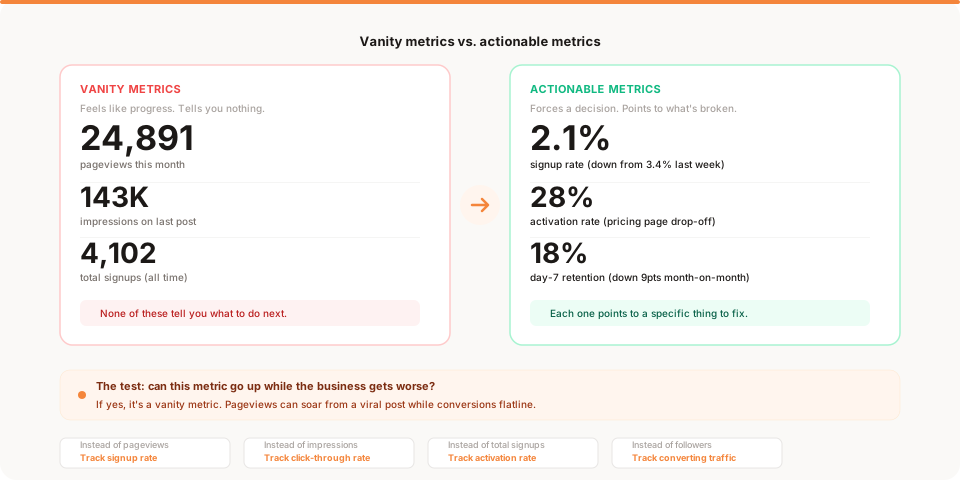
A vanity metric can go up while your business gets worse. An actionable metric forces a decision. The difference is not the number itself — it is whether context tells you what to do next.
There is a specific feeling you get when your traffic spikes.
You ship something, share it, and suddenly the chart goes vertical. Thousands of visitors. Comments rolling in. The counter climbing in real time. It feels like something is happening.
Then you check signups. Twelve.
Then you check revenue. Unchanged.
The spike fades. The number settles back where it was. And the product is exactly where it was a week ago.
This is the vanity metric trap. The problem is not that the traffic was fake. The problem is that you were watching a number that looked like progress but was not connected to anything real.
Why founders track the wrong numbers
It is not carelessness. There are real reasons why founders end up staring at metrics that do not matter.
The first reason is availability. Total pageviews, follower counts, and impression numbers are front and center in every tool. They are easy to find, easy to understand, and they usually go up. When you are building something and feeling uncertain, a number that goes up is psychologically comforting.
The second reason is external validation. Pageviews and follower counts are visible to others. You can screenshot a traffic spike and post it. You cannot screenshot your activation rate going from 22% to 31% and make it feel equally compelling. But the activation rate change is the one that matters.
The third reason is that vanity metrics rarely cause visible harm. If your signup rate drops, you notice quickly because signups stop arriving. If your total impression count plateaus, nothing obviously breaks. The consequence is invisible, which makes it easy to keep checking the comforting number.
Understanding this is not about self-criticism. It is about recognizing the pull so you can resist it deliberately.
What actually makes a metric "vanity"
There is a simple test. Apply it to any metric you are considering:
Can this metric go up while the business gets worse?
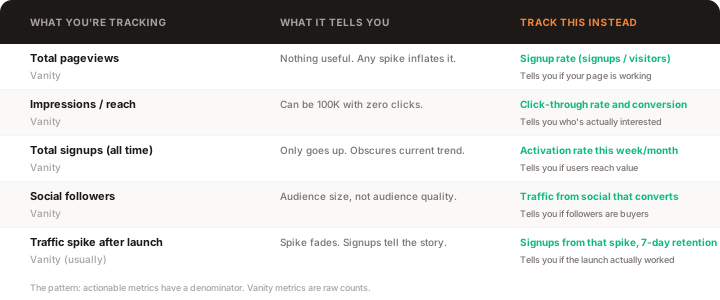
Pageviews: yes. A viral post can drive 50,000 visitors who sign up at 0.1%. Traffic is up. Signups are down.
Total signups (all time): yes. This number literally cannot go down. It is a cumulative count. It tells you nothing about what is happening right now.
Impressions: yes. A post can rack up 100,000 impressions with 80 clicks. Visibility without any action.
Social followers: yes. You can have 10,000 followers and get 4 clicks per post. Audience size without audience quality.
Contrast those with metrics where the answer is no:
Signup rate (signups divided by visitors): if this goes up, more of the people who arrive are actually signing up. You cannot game it with volume.
Activation rate (users who hit the key action divided by total signups): if this goes up, more users are finding the core value of the product. It reflects the product experience, not the marketing.
Day-7 retention: if this goes up, users are coming back. Nothing inflates it except the product actually working.
The vanity metrics are almost all raw counts. The actionable ones are almost all rates. A denominator changes everything.
The metrics that look real but aren't
Some metrics feel serious because they come from a proper analytics tool, are displayed in a chart with axis labels, and get discussed in founder communities. They can still be vanity metrics.
Traffic spikes
A traffic spike is exciting. It is also usually irrelevant to your actual growth unless you check what the spike converted at.
If your normal baseline is 500 visitors per week at 3% signup rate, and you get a launch week with 8,000 visitors at 0.4% signup rate, did the launch help? You got 32 signups from 8,000 visitors instead of 15 from 500. The absolute number looks good. But the signal is that the 8,000 visitors are a different, lower-intent audience than your normal traffic.
That is exactly the pattern in traffic is up but conversions are down. Traffic volume and traffic quality are different things. Watching one without the other gives you an incomplete picture.
Raw signups (especially all-time)
Total signups is one of the most commonly celebrated metrics in early-stage products. "We crossed 1,000 users" is a milestone founders announce. But cumulative counts are almost always vanity: they only go up, and they say nothing about what is happening this week.
More useful: signups this week compared to last week, and the activation rate for those signups. That tells you if your current acquisition is working and if those new users are actually getting value. For a deeper look at what to do once users arrive, the post on what is user activation covers this specifically.
Impressions
Impressions tell you how many times your content was displayed. They measure distribution, not interest. A post can have 200,000 impressions and generate 90 clicks. Another post can have 4,000 impressions and generate 600 clicks. Which one worked?
If you optimize for impressions, you will write content that gets shown widely but clicked rarely. The metric pulls you toward breadth when you need depth.
App downloads
For mobile products, download counts suffer the same problem as total signups. A download means someone tapped a button. It says nothing about whether they opened the app, completed onboarding, or came back a second day. Daily active users divided by total downloads is a much harder but much more honest number.
What makes a metric actually useful
A useful metric has three properties.
It has a denominator. Rates and ratios reflect quality. Raw counts reflect volume. When you divide signups by visitors, you are asking "what percentage of the people we reach are choosing to sign up?" That question has meaning regardless of whether volume goes up or down.
It changes when something specific breaks or improves. A good metric points at something. If your pricing page bounce rate goes from 45% to 70%, you know exactly what page to investigate and fix. If your total pageviews drop by 30%, you have a direction but not a cause.
You would do something different based on it. This is the decision test. If your signup rate dropped from 3% to 1.5% tomorrow, you would look at the signup page, check if something changed, and investigate. If your total impressions dropped by the same proportion, what would you actually do? If the answer is "not sure," the metric is not telling you enough to act on.
The metrics worth watching
This is not a comprehensive list. There is a more detailed breakdown in the post on the five metrics that matter for small products. But these are the core ones to anchor on.
Signup rate. What percentage of visitors to your site are signing up? This is the clearest signal of whether your landing page and positioning are working. If traffic is steady and this drops, something on the page changed or broke. If traffic is growing and this stays flat, the new traffic is lower intent than your original audience.
Activation rate. Of the people who sign up, what percentage complete the first meaningful action in your product? This is the single best measure of whether your onboarding delivers on the promise of the landing page. Low activation with decent signup rate means the gap is in the product experience, not the marketing.
Day-7 retention. What percentage of new users come back within a week? This tells you whether the product is delivering enough value to create a return habit. For context and benchmarks, the post on why users don't come back covers what normal and broken look like.
Conversion rate by source. Not total traffic by source, but conversion rate by source. The channel that brings the most traffic is not always the channel that brings the users who actually sign up and stay. Knowing which source converts best tells you where to double down.
Bounce rate on specific pages. Overall bounce rate is vanity. Bounce rate on your pricing page, your signup page, or your highest-traffic landing page is actionable. High bounce on a specific high-intent page tells you exactly where to focus.
The mental shift: from reporting to deciding
There is a version of analytics where you check your dashboard, confirm the charts are trending the right direction, and close the tab feeling like you have done something. This is analytics as reporting.
There is a different version where you open your data asking a specific question and leave with either a decision or a next question to investigate. This is analytics as thinking.
The difference is not the tool. It is the habit of asking what you will do differently based on what you see. The three-question framework in how to act on your website data is built around exactly this: what happened, why did it happen, what should I do.
Vanity metrics make it easy to feel like you are in the first mode when you need to be in the second. You look at a big number, feel reassured, and move on. Nothing changes.
A practical framework
This is the filter to run any candidate metric through before adding it to what you watch regularly.
Track it if:
- It has a denominator (it is a rate, not a count)
- A change in it would cause you to investigate or act
- It reflects the health of a specific step in your funnel
Ignore it for now if:
- It only goes up over time (cumulative counts)
- It measures reach or distribution without connecting to action
- You would need three more data points to interpret it meaningfully
Act on it when:
- It changes by more than 20% in either direction
- The change persists for more than a few days
- It is a metric close to conversion (signup rate, activation rate) rather than far upstream (impressions, followers)
Two scenarios
Scenario one. You post on Product Hunt. Your traffic goes from 300 to 4,800 visitors in a day. You get 12 signups. Your signup rate was 3.2% before the launch. On launch day, it is 0.25%.
The vanity read: "Our launch drove 4,800 visitors." The dashboard looks exciting.
The actionable read: "Product Hunt traffic converts at 0.25% for us. Our core audience converts at 3.2%. We should not optimize our landing page for the Product Hunt audience. We should figure out where our 3.2% audience comes from and do more of that."
Scenario two. You make no announcement. Traffic stays flat at 320 visitors per week. But your signup rate climbs from 2.1% to 3.8% after you rewrote the hero section.
The vanity read: nothing exciting to report. Traffic is flat.
The actionable read: "The hero rewrite is working. It converts significantly better. This is worth more experiments on the same page."
In scenario one, the vanity metric (traffic) signals success. The actionable metric (conversion rate) reveals a more complicated story. In scenario two, the vanity metric (traffic) signals nothing. The actionable metric quietly tells you something important is working.
The principle underneath all of this
Raw counts measure how big the top of your funnel is. Rates and ratios measure how well each step of the funnel works.
You need both kinds of information, but they answer different questions. Traffic tells you if people are finding you. Signup rate tells you if the right people are finding you. Activation rate tells you if the product delivers what you promised. Retention tells you if it delivers it consistently enough to become a habit.
The founders who make the fastest progress are not the ones who get the most traffic or the most signups. They are the ones who understand where the gaps are and fix them one at a time. That requires knowing which numbers to look at.
A dashboard full of climbing charts feels good. A dashboard that shows a 19% activation rate and a 12% day-7 retention rate feels uncomfortable. But the second one is telling you the truth. And the truth is where the leverage is.
Keep reading
- How to analyze your website data: once you know which metrics matter, here is the step-by-step process for reading them
- The 5 metrics that actually matter for small products: the specific metrics to track and what to do with each
- How to act on your website data: the three-question framework for turning numbers into decisions
- Traffic is up but conversions are down: what to do when traffic and signups tell different stories
- Muro for founders: analytics that surfaces the metrics that matter, not the ones that just look good