Illustrative case study
Traffic increased 60% but signups dropped. Here is what the founder fixed
A multi-channel launch pushed traffic to an all-time high. But signups went the wrong direction. The problem was not the product or the landing page. It was where the traffic was coming from.
3.2% → 1.9%
Signup rate drop
→ 2.8%
Recovery after fix
3 weeks
Time to diagnose
This is an illustrative case study. It is based on a real and common pattern that SaaS founders encounter after multi-channel launches. The numbers and context are representative, not drawn from a specific named customer. If you are seeing a similar gap between traffic growth and conversion rate, the diagnostic approach here is the same one you would use.
Quick summary
A founder pushed a SaaS product across Reddit, Twitter, and a few smaller communities. Traffic jumped 60% in two weeks. The founder assumed this was a win.
But signups actually dropped. The overall conversion rate fell from 3.2% to 1.9%. The dashboard showed green on traffic and red on everything else.
After digging into the source-level data, the cause was clear: the largest traffic source (Reddit) was sending high-volume, low-intent visitors. The landing page was not failing. The audience was wrong.
The fix was not a page redesign. It was a shift in focus: spending more time on the channels that sent real users, adjusting messaging for different traffic sources, and letting go of the vanity of a high traffic number.
The situation after the launch push
The product was a lightweight scheduling tool built for freelancers. It had been live for about seven months. Monthly traffic was around 3,200 visitors, growing slowly from organic search and a small newsletter audience. The conversion rate from visitor to signup had been sitting steady at about 3.2% for six weeks.
The founder wanted to accelerate. They drafted a detailed post for a relevant subreddit explaining the problem the tool solves. They wrote a shorter, sharper thread for Twitter. They shared the product in two small Slack communities for freelancers.
Over the next two weeks, traffic increased from 800 per week to about 2,100 per week. The Reddit post did especially well, hitting the front page of the subreddit and driving a sustained spike over about five days.
From a traditional dashboard, this looked like the best two weeks the product had ever had. Traffic charts were climbing. Unique visitors were at an all-time high. The numbers felt like momentum.
Why the traffic looked like a win
The founder checked the analytics dashboard on Monday morning, the way they always did, and saw the weekly visitor count had nearly tripled. The chart was green. The number was up and to the right.
At that moment, the instinct was to celebrate and keep pushing. More Reddit posts. More threads. More distribution.
This is the trap that vanity metrics create for founders. Traffic volume is a number that always feels like progress. A line going up triggers a dopamine response regardless of what the traffic actually does once it arrives.
But traffic is not a success metric. Traffic is an input. The output is what happens after visitors arrive: do they sign up, do they activate, do they come back. And the output was getting worse, not better.
What the data actually showed
The founder almost missed the problem because they were looking at the wrong chart. Traffic was the headline number. It was the biggest number. It looked the healthiest.
But when they checked the signup count, the picture changed. Signups had not grown proportionally with traffic. In fact, the raw number of weekly signups had barely moved: it went from about 26 per week to about 30 per week, despite traffic nearly tripling.
The conversion rate told the real story: it had dropped from 3.2% to 1.9%.

This is a pattern that shows up regularly after multi-channel launches. It is the same dynamic covered in detail in traffic is up but conversions are down: more visitors who do not match your audience dilute the conversion rate without producing proportional signups. The blended average makes it look like the page is suddenly broken when it is not.
Where the conversion problem actually was
The breakthrough came when the founder stopped looking at traffic as one number and started looking at it by source.
The breakdown told a story that the aggregate had hidden:
- Reddit contributed 55% of all traffic but only 18% of signups
- Twitter contributed 20% of all traffic but 42% of signups
- Other sources (organic, direct, newsletter, Slack communities) contributed 25% of traffic and 40% of signups
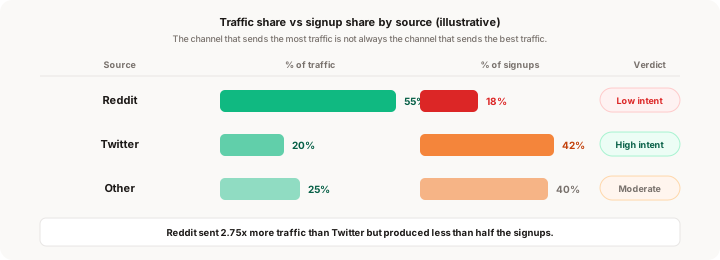
Reddit was sending 2.75 times more traffic than Twitter but producing less than half the signups. The Reddit visitors were browsing, not buying. They were curious about the concept but not in the market for a scheduling tool. Many of them were developers or hobbyists who read the post, clicked through, looked at the landing page, and left within seconds.
Twitter, by contrast, was reaching people who already had the problem the tool solves. The founder's thread had described the specific frustration of managing freelance scheduling manually, and the people who resonated with it were freelancers actively dealing with that problem. They arrived with intent.
The other sources, organic search and the newsletter, were performing the way they always had. Their conversion rates were unchanged. The product and landing page were fine for the right audience. The problem was entirely a traffic mix issue.
This is the fundamental lesson of which traffic source converts best: volume and quality are separate dimensions, and measuring only volume hides the quality signal.
What the founder changed
The fix was not dramatic. It was a reallocation of energy and a few small adjustments.
1. Shifted time from Reddit to Twitter and newsletter.
The founder had been spending about 60% of their distribution time preparing Reddit posts and 20% on Twitter. They flipped that ratio. Not because Reddit was bad, but because Twitter was producing 4x the signups per visitor. The math was simple: an hour spent writing a good Twitter thread produced more signups than an hour spent writing a Reddit post.
2. Adjusted landing page headline for clarity.
The original headline was clever but assumed familiarity with the problem. It worked well for visitors from the newsletter and Twitter, who already understood the pain point. But for cold Reddit traffic, it did not communicate the product's purpose quickly enough.
The founder did not create a separate landing page. They tightened the headline to be clearer for people encountering the product for the first time, without losing the tone that resonated with their core audience. One sentence, rewritten.
3. Added a brief context line for social traffic.
Below the headline, the founder added a short explanatory line that described who the tool was for: "For freelancers who waste time coordinating scheduling across clients." This line was always implied by the page but never stated. Stating it explicitly helped cold traffic self-select faster.
4. Stopped optimizing for total visitor count.
This was the most important change, and it was not a product change at all. The founder stopped treating weekly traffic as a success metric and started tracking signups by source as the primary number. That shift in attention meant decisions were driven by what actually moved signups, not what made the traffic chart look good.
Results after the changes
Three weeks after making these adjustments, the numbers had shifted meaningfully.
The overall signup rate recovered from its low of 1.9% to 2.8%. It did not return fully to the pre-launch baseline of 3.2% because the traffic mix still included some Reddit visitors, but the quality of the average visitor had improved significantly.

More importantly, the absolute number of signups went up. Weekly signups increased from about 30 (during the high-traffic, low-conversion period) to about 38 (after the adjustments), on slightly lower total traffic. The founder was getting more signups with fewer visitors because a higher proportion of those visitors matched the audience.
Twitter-sourced signups specifically increased by about 35%, driven by the higher output of threads and the clearer landing page headline. Newsletter signups also ticked up, likely because the improved headline worked for that audience too.
The founder did not stop posting on Reddit entirely. They shifted to more targeted subreddits where freelancers actually discussed scheduling problems, rather than broader communities where the topic was interesting but not urgent.
What other founders can learn from this
This is not a story about Reddit being a bad channel. It is a story about the difference between traffic that is curious and traffic that is ready.
Volume is an input, not an outcome. A week with 2,300 visitors and 30 signups is not better than a week with 900 visitors and 29 signups. The second week is cheaper, more efficient, and easier to sustain. But most dashboards present the first week as the success because the biggest number is bigger. If your dashboard is doing this to you, it is worth understanding which metrics are vanity and which are actionable.
Break down conversion by source before making changes. If overall conversion drops after a traffic increase, the most likely explanation is traffic quality, not a page problem. Before rewriting headlines, redesigning layouts, or questioning your product, check whether the sources that were already converting are still converting at the same rate. If they are, the page is fine. The new traffic simply does not match. This is the exact diagnostic covered in how to act on your website data.
Spend distribution time proportional to conversion, not volume. If Twitter produces 4x the signups per visitor compared to Reddit, an hour of Twitter effort is worth four hours of Reddit effort in terms of acquisition impact. Most founders allocate time based on which platform feels most active or which post got the most engagement. Neither of those maps to signups.
Cold traffic needs an explicit value statement. Visitors from communities who have never heard of your product need the headline to explain what the product does and who it is for. Visitors from your newsletter already know. The headline has to serve both, and the most common failure mode is writing for the audience that already understands you while losing the audience that does not.
Let go of the traffic number. This is the hardest change for most founders. Watching a traffic chart climb feels like progress. Watching it flatten or decline after you shift strategy feels like regression. But if signups are growing while traffic stays flat, your product is getting healthier. The numbers that matter are downstream of traffic, not traffic itself.
FAQ
Why does traffic from Reddit often convert poorly? Reddit traffic is typically discovery-driven, not intent-driven. People browse Reddit for entertainment and curiosity. When a product post shows up in a subreddit, visitors click because the topic is interesting, not because they are actively looking for a solution. This is true even in niche subreddits. The behavior pattern is closer to browsing a magazine than searching for a product. Some visitors will convert, but the conversion rate is structurally lower than channels where the visitor already has the problem and is looking for a fix.
Should I stop posting on Reddit entirely? No. Reddit can still drive valuable traffic if you target the right communities. The key is matching the subreddit to your actual user base, not to the broadest audience that might find your product interesting. A small, focused subreddit where your target users discuss the exact problem your product solves will outperform a large subreddit where the topic is adjacent. Also, Reddit is useful for brand awareness and feedback, even when conversion is low.
How do I know if my conversion drop is caused by traffic quality or a page problem? Check conversion rate by source. If the sources that were converting before the traffic increase are still converting at the same rate, the page is fine. The new traffic is diluting the average. If all sources, including your previously healthy ones, are converting worse, the page has a problem. This single split is the fastest diagnostic you can run.
How much traffic do I need before source-level analysis is useful? You need at least 100 to 200 visitors per source over a one-to-two week period to draw meaningful conclusions. Below that threshold, a single unusual visitor or bot hit can distort the conversion rate enough to mislead you. If one source is too small for reliable data, focus on the sources where you do have enough volume and revisit the smaller one after it accumulates more visits.
What is a realistic conversion rate to aim for from social traffic? For most SaaS products, social traffic (Twitter, Reddit, LinkedIn) converts between 0.3% and 2%, depending on how targeted the audience is. Organic search traffic typically converts at 2% to 5%. Email and newsletter traffic can reach 5% to 15%. These ranges are rough. The more useful target is your own historical rate per source, not an external benchmark.
See this kind of breakdown in your own product
The gap in this scenario was hidden for weeks because the default view was a blended average. The data was there the whole time. Nothing was prompting the founder to split it by source.
Muro is built to surface exactly this kind of signal. When traffic goes up but conversions go down, Muro flags it and shows you which source is causing the divergence. You do not need to build a custom report or know which question to ask. The question is asked for you.
If you are running distribution across multiple channels right now and you are not sure which one is actually producing signups, that is the gap Muro closes.