What is a north star metric (and how to choose one for your product)
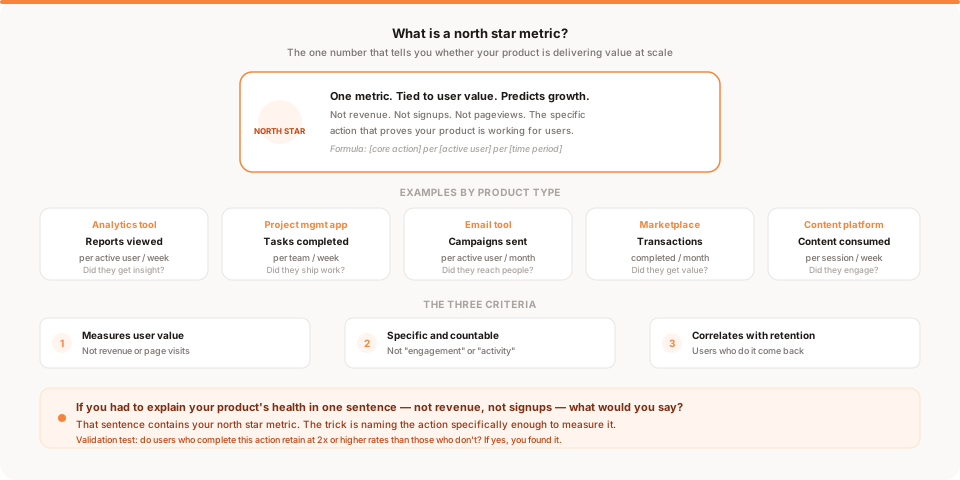
A north star metric is the one action that proves your product is delivering value to users — not revenue, not signups, but the specific thing users do when they get what you promised. Finding yours is the most clarifying thing you can do for your product strategy.
Ask most founders what their most important metric is and you will get one of two answers: revenue, or some variant of "we track a lot of things."
Both are symptoms of the same problem. Revenue is an output — it tells you whether the business is capturing value, not whether users are getting it. And tracking many things without a clear priority means you are constantly deciding which number to act on, which means you are never fully acting on any of them.
A north star metric fixes this. Not by adding another metric to your dashboard. By replacing the scattered collection of numbers with one signal that tells you whether the product is fundamentally working.
What a north star metric actually is
A north star metric is the specific action that proves your product is delivering its core value to users — measured consistently over time.
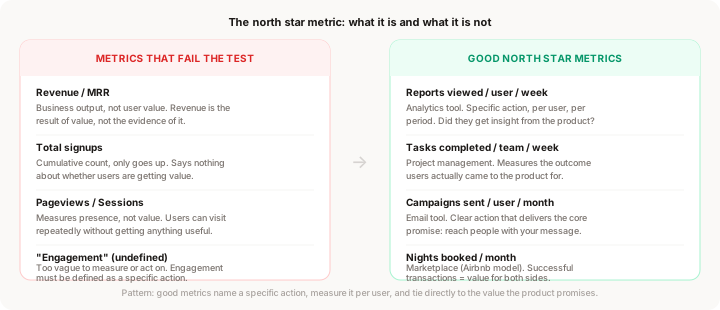
It is not revenue. Revenue is what the business gets when the product delivers value. The north star is the evidence that value is being delivered.
It is not signups or traffic. Those measure how many people arrived at the door. The north star measures whether the people inside are getting what they came for.
It is not "engagement" in the abstract. Engagement means nothing until you define it. A north star metric is always a specific, countable action.
The pattern that almost every good north star metric follows: a core action, per active user, per time period.
- "Reports viewed per active user per week" for an analytics tool
- "Messages sent per active user per day" for a messaging product
- "Tasks completed per team per week" for a project management app
- "Nights booked per month" for a marketplace
- "Campaigns sent per active user per month" for an email tool
Each one names what the user actually does when the product is working. Not what the business receives. What the user gets.
Why it matters more than you might expect
Having a north star metric changes how you make decisions, not just how you measure outcomes.
It tells you whether the business is healthy before revenue does
Revenue is a lagging indicator. It tells you what happened based on decisions made weeks or months ago. A north star metric is a leading indicator — it measures user behavior in real time. When the north star goes up, revenue typically follows. When it goes down, revenue problems are coming before they show up in the financials.
This is why retention is the metric most closely tied to the north star. Users who complete the core value action retain at dramatically higher rates than those who don't. If your north star is declining, your retention will follow. And if retention falls, so does everything downstream.
It cuts through prioritization debates
Without a north star metric, every feature request and product decision goes through the same vague filter: "Does this seem like a good idea?" With one, you have a concrete test: "Will this improve the rate at which users complete the core value action?"
This is not just a measurement benefit. It is a decision-making filter. Features that score well become priorities. Features that do not get questioned harder. The north star gives you a reason to say no that everyone on the team can understand.
It keeps you honest about what the product actually does
Companies sometimes discover that what they think the product does and what users actually get from it are different. The north star metric makes this visible. If your product claims to help teams ship work faster but the core action most correlated with retention is "file uploaded," you have learned something important about what users are actually using the product for.
Examples across product types
Different products have fundamentally different north star metrics because they deliver different kinds of value.
SaaS tools
For software-as-a-service products, the north star usually measures productive use of the core feature. Not login rate or session count — those measure presence, not value.
An analytics tool: reports generated or insights delivered per user per week. Did the user get information they can act on?
A CRM: contacts updated or deals progressed per user per week. Is the user actively managing their pipeline?
A note-taking tool: notes created or documents written per active user per week. Is the user actually capturing thoughts?
The pattern: what output does the user produce when using the product correctly?
Marketplaces
For two-sided markets, the north star usually sits at the transaction level — the moment both sides get value simultaneously.
Completed bookings, successful transactions, or matched requests per month. The moment the transaction completes is the moment both the buyer and the seller got what they came for.
Marketplace metrics that fail this test: total listings (supply-side only), total searches (intent, not value), and total messages sent (conversation is not transaction).
Content products
For content platforms, the north star measures consumption and return behavior rather than creation.
Articles read per user per session, podcasts listened to per active user per week, or videos watched to completion per user per week. The question is whether users are getting the content they came for, not just visiting the platform.
The trap here is measuring total content consumed rather than per-user consumption. Total consumption goes up as you grow. Per-user consumption tells you whether the experience is getting better or worse for existing users.
Communication tools
For communication products like team chat or async video, the north star is usually messages sent, conversations initiated, or responses exchanged per active user per period. The product works when people are using it to actually communicate. If users log in but don't send anything, they're not getting value.
How to choose the right one for your product
There are three criteria. A good north star metric passes all three.
Criterion 1: It measures value delivered to users, not to the business
Revenue, MRR, and subscriptions measure what the business receives. Sessions, pageviews, and logins measure presence. Neither of those is the core value the product delivers to users.
Ask: what is the user trying to accomplish when they use this product? What does a successful session look like from their perspective? The action that answers that question is the starting point.
Criterion 2: It is specific enough to count and track
"User engagement" is not a north star metric. It is a direction. To be useful, you need to specify the exact action. Not "uses the product" but "creates a report." Not "communicates" but "sends a message." Not "is active" but "completes a task."
The test: can you write a database query that returns this number? If the definition is vague enough that two engineers would implement it differently, it is not specific enough.
Criterion 3: It correlates with retention
This is the validation test. Once you have a candidate metric, check whether users who complete that action at a regular cadence retain at significantly higher rates than users who don't.
Look at two groups: users who completed the action in their first week versus users who didn't. What does 30-day retention look like for each group? If the difference is large — say, 40% retention versus 8% — you have found a meaningful signal. If the difference is small, the action you chose may not be the real value driver. Activation rate works the same way: the action you define as activation should be the one most predictive of retention.
This test does not require a sophisticated data setup. It requires counting two user cohorts and comparing their return rate. Any analytics tool can do it.
Common mistakes
Choosing a revenue metric
This is the most common mistake, especially for founders with a commercial mindset. Revenue is what you care about, so it feels like the right thing to optimize.
But revenue is an output. When you optimize for revenue directly, you end up pushing users toward upgrades and purchases rather than toward value. Short term, this can work. Longer term, users who don't get genuine value churn, and the revenue foundation erodes.
Optimize for value delivery. Revenue follows.
Choosing too many
Some teams define a primary metric and then five secondary ones that are "also important." This defeats the purpose. The point of the north star is that it is singular. One number. When everything is a priority, nothing is.
If you find yourself saying "well, but we also need to track X," either X is a supporting metric that explains why the north star goes up or down (fine to track, not the north star), or you haven't clearly defined what your product is for.
Choosing a metric that can't go down
Cumulative totals — total users, total messages ever sent, total revenue all time — only go up. They cannot go down, which means they cannot tell you when something is wrong. A north star metric needs to be capable of declining. If it can't get worse, it can't be a signal.
This is the same reason vanity metrics fail as a measurement strategy. A metric that only goes up measures the past, not the present.
Optimizing the metric instead of the behavior
Once a metric is visible, there is pressure to improve it by any means. If the metric is "messages sent per user," a lazy implementation would be to send notification spam that drives users to reply. Messages go up. Genuine value does not.
A north star metric should be hard to game without also delivering real value. If you can improve it without genuinely improving the product for users, you have chosen the wrong metric or you are measuring it in the wrong way.
How to use it in practice
Track it weekly, not daily. Daily north star numbers fluctuate from normal variation. Weekly numbers smooth out the noise and show you real trends.
Make it visible to everyone who works on the product. The north star metric should not live in a private dashboard. When designers, engineers, and product people all see the same number, prioritization conversations become cleaner.
Evaluate features against it before building. Before adding a feature, ask: "What is our hypothesis for how this will improve the north star?" If you cannot answer that question, the feature is likely nice to have rather than important to have.
Investigate before acting on a single week's change. A drop in one week is noise. A drop for two or three consecutive weeks is signal. Before changing strategy, confirm that the change is real and persistent.
Connect it to the supporting metrics. The north star tells you whether the overall system is working. The 7 foundational metrics — especially activation, retention, and funnel drop-off — tell you why. When the north star declines, look at those supporting metrics to find out which stage broke.
How the north star connects to everything else
The north star metric sits in the middle of your measurement system.
Traffic and conversion feed users into the product. Activation is the first evidence that a new user might hit the north star. Retention measures whether they continue to. Revenue is what happens when enough users hit the north star consistently.
When your north star goes up, something upstream improved: better acquisition quality, better onboarding, better product experience. When it goes down, something upstream broke: a drop-off in activation, a retention problem, or a feature change that reduced the core behavior.
This connection is why the north star is more powerful than any individual funnel metric. It does not live at one stage. It lives across all of them, as the signal that the whole system is working.
Finding yours
If you do not yet have a north star metric, the place to start is with your retained users.
Look at your users who have stayed active for 60 or more days. What do they have in common? What do they do regularly that newer users or churned users do not? The behavior that differentiates your long-term retained users from everyone else is almost certainly your north star metric.
If you are earlier stage and do not have enough retained users to compare, start by defining the core value your product promises and naming the specific action a user takes when they receive that value. Run the retention correlation test once you have enough data.
You do not need the perfect metric immediately. A reasonable, specific, user-value metric that you can start tracking now is far more valuable than waiting for the perfect answer. You will refine it over time as you understand your users better.
Keep reading
- The 7 most important metrics every startup should track: how the north star connects to the full metrics system
- What is user activation: defining the first step toward your north star for new users
- Why users don't come back: retention — the metric most closely tied to north star health
- Vanity metrics vs real metrics: the framework for telling useful metrics apart from misleading ones
- Muro for founders: analytics that surfaces the signals that matter without requiring a dashboard session