The 7 most important metrics every startup should track
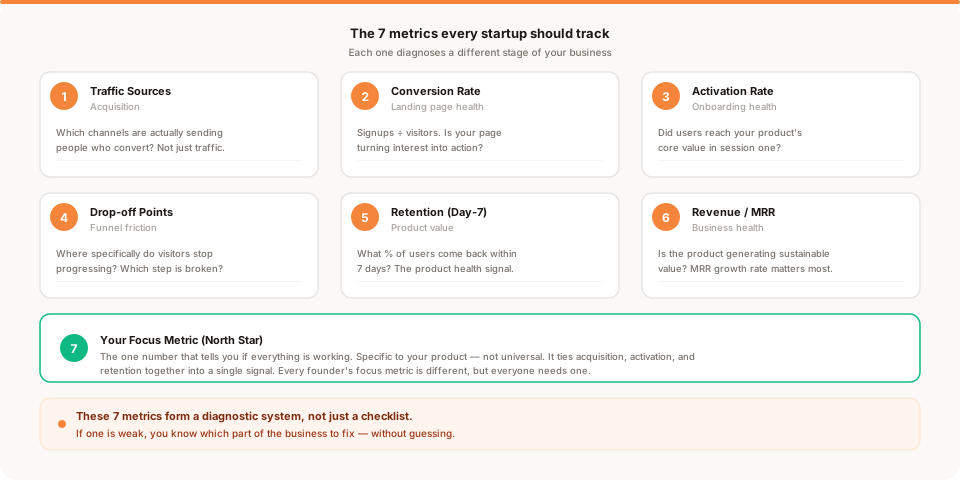
The 7 metrics are not a checklist. They are a diagnostic system. Each one tells you whether a different stage of your business is working. When something is off, you know exactly which stage to fix.
Most startups track too many numbers and learn almost nothing from them.
They have a dashboard with 30 metrics, check it every morning, and still end up guessing which part of the business to fix. The problem is not a lack of data. It is a lack of a clear framework for what the data means.
The 7 metrics in this guide are not a random list. They are a diagnostic system. Each one tells you whether a specific stage of your business is working. When you look at them together, you can read exactly where the growth is breaking down without guessing.
Why tracking the wrong metrics is expensive
When you track a metric that does not connect to a decision, you pay a real cost: time spent checking something that cannot tell you what to do.
Vanity metrics are the most common version of this. Total pageviews, total signups (all time), social followers, and impressions all feel like progress but none of them tell you what to fix. A product can have 50,000 total signups and terrible growth because the most recent signups are not activating and not returning.
The 7 metrics below are different. Each one is a rate or a specific measurement that can go up or down, and when it moves, it tells you what happened and where to look. They are the smallest set that covers every stage from acquisition to revenue.
What makes a metric worth tracking
Before getting into the list, a quick filter you can apply to any metric you are considering:
If this number changed significantly tomorrow, would I know what to do differently?
If your answer is yes, it is a useful metric. If your answer is "not sure," the metric is either too vague or too far from the decisions you can actually make.
Every metric on this list passes that test. When conversion rate drops, you investigate the landing page. When day-7 retention drops, you investigate the product experience or re-engagement. When activation drops, you investigate onboarding. Clear number, clear stage, clear next step.
The 7 metrics

1. Traffic by source
What it measures: Where your visitors come from — organic search, social, direct, referral, paid.
Why it matters: Not all traffic is equal. 1,000 visitors from Google search and 1,000 visitors from a viral social post are completely different signals. One is a repeatable, compounding acquisition channel. The other is a one-time spike. If you only track total traffic, you cannot tell the difference.
Breaking traffic down by source also tells you where to invest your next hour. If organic search is growing week over week, that compound channel is worth feeding. If social traffic has a 0.3% conversion rate and organic has a 4% rate, the lesson is clear: do more of whatever produces organic.
How to think about it: Every week, ask which source is growing and which converts best. Those two answers tell you where to focus acquisition effort. For a deeper guide on evaluating which channels are actually worth your time, which traffic source converts best covers this specifically.
What good looks like: One or two sources growing week over week, with at least one converting above 2%.
2. Conversion rate
What it measures: What percentage of visitors sign up or take your desired action. Formula: signups divided by visitors.
Why it matters: This is the single most important metric for your marketing site. It tells you whether the right visitors are arriving and whether your page is working. A low conversion rate with decent traffic means the landing page is the bottleneck. A decent conversion rate with low traffic means the page is fine but you need more visitors.
Most founders do not separate these two problems clearly enough. They try to improve conversion and grow traffic at the same time and cannot tell which change helped. Tracking conversion rate separately gives you a clean signal about your page specifically.
How to think about it: 2% to 5% is typical for early products. Below 1% means something is wrong with positioning, messaging, or traffic quality. Above 5% is strong and means the constraint is traffic volume, not the page. For a detailed breakdown of what causes low conversion rates, why your conversion rate is low walks through the specific causes.
What good looks like: Rate above 2% and trending upward month over month.
3. Activation rate
What it measures: What percentage of signups complete the first meaningful action in your product. The specific action depends on what your product does.
Why it matters: Signup and activation are not the same thing, and conflating them is one of the most common early mistakes. A user who signed up but never used the product is not a user. They are an abandoned account.
Activation rate tells you whether your onboarding is delivering on the promise of your landing page. If 1,000 people sign up but only 150 activate, you do not have 1,000 users. You have 150 users and 850 people who decided the product was not for them before they saw what it could do.
How to think about it: 30% to 55% is a healthy range for most early SaaS products. Below 25% usually means the onboarding is too complex, the first experience does not match the marketing, or the product has a long time-to-value. For a complete guide to defining and measuring activation, what is user activation goes deep on this.
What good looks like: Above 30%, trending upward, with most activation happening in the first session.
4. Drop-off points
What it measures: The specific steps in your funnel where visitors stop progressing. Not a single number but a sequential analysis of the gaps between stages.
Why it matters: Conversion rate and activation rate tell you that there is a problem. Drop-off analysis tells you exactly where the problem is. The difference is like knowing your car is slow versus knowing the rear left tire is flat.
When you look at how many visitors reach each step in your funnel (homepage, pricing page, signup page, signup complete, activation), the biggest gap between consecutive steps is your highest-leverage fix. You do not need to redesign the entire product. You need to fix the one transition where the most people are leaving.
How to think about it: Find the step with the largest absolute drop. Fix that step, one change at a time. Check again in a week. Where users drop off on your website walks through this framework with detailed examples. For the specific case of drop-off inside the signup flow itself, why users don't complete signup covers the six most common causes.
What good looks like: No single step losing more than 60% of users who reach it.
5. Day-7 retention
What it measures: What percentage of new users return to the product within 7 days of signing up.
Why it matters: This is the clearest signal of whether your product delivers sustained value, not just first-session interest. A product that activates users but does not retain them is a leaky bucket. Every new user you acquire drains out before compounding into an engaged base.
Activated users retain at 3 to 10 times the rate of non-activated users. This means your retention problem is usually actually an activation problem. If you fix activation first and retention still looks weak, the product itself needs attention.
How to think about it: Below 15% at day 7 is a signal that onboarding or core value delivery needs urgent work. 20% to 40% is a reasonable range for early products. Above 40% is strong. The more important question is: are activated users retaining above 35%? If yes and overall retention is low, the fix is getting more users through activation. If even activated users are not coming back, the product experience after the first session needs work. Why users don't come back covers both types of retention problems in detail.
What good looks like: Day-7 retention above 25% overall, above 35% for activated users.
6. Revenue or key outcome metric
What it measures: Monthly recurring revenue (MRR), MRR growth rate, or the revenue proxy most relevant to your stage (trial conversions, paid upgrades, revenue per user).
Why it matters: The previous five metrics are all leading indicators. Revenue is the lagging indicator that confirms whether everything above it is actually producing business value. High traffic, high conversion, high activation, and high retention should eventually produce revenue growth. If they do not, either pricing or the product-market fit needs attention.
How to think about it: For pre-revenue products, track the metric closest to revenue: trial-to-paid conversion rate, paid waitlist signups, or upgrade rate from free to paid. For products with any paying users, track MRR and MRR growth rate. Net revenue retention (do existing customers expand, shrink, or churn?) becomes important once you have meaningful MRR. Aim for MRR growing at least 10% per month at the early stage.
What good looks like: MRR growing month over month, with growth rate stable or improving.
7. Your focus metric
What it measures: The one number that best captures whether your product is delivering value to users at scale. It is specific to your product and ties together multiple stages of the funnel.
Why it matters: The first six metrics are universal. This one is unique to you. It is the metric that, when it goes up, you know the business is healthy. When it goes down, you know something is wrong even before you know which stage is the cause.
For a messaging product, it might be messages sent per active user per week. For an analytics tool, it might be reports generated per user. For a project management app, it might be tasks completed per team per week. The pattern is always the same: an action that represents genuine ongoing use of the core value, measured per active user rather than in total.
Finding your focus metric requires some experimentation. Look for the metric most strongly correlated with retention. If users who do action X retain at significantly higher rates than users who do not, action X (measured regularly) is probably your focus metric.
How to think about it: You do not need to define this on day one. Start with the first six metrics. Once you have 3 to 6 months of data, look for the behavior most correlated with retention and revenue. That behavior, measured per active user, is your focus metric.
What good looks like: Growing week over week, correlated with retention and revenue growth.
How these 7 metrics work as a system
The power of this set is not in any individual metric. It is in how they connect.
Work from left to right in the funnel:
- Traffic is low: acquisition problem. You need more channels or better distribution.
- Traffic is fine but conversion is low: landing page problem. The page is not matching visitor intent or not communicating value.
- Conversion is fine but activation is low: onboarding problem. The product is not delivering on the promise fast enough.
- Activation is fine but retention is low: product value problem. Users get to value but it is not enough to bring them back.
- Retention is fine but revenue is low: monetization problem. Value is being delivered but not captured.
The first metric in this sequence that looks wrong tells you where to focus. You do not need to fix everything. You need to fix the first bottleneck.
This is why the metrics work together as a diagnostic system and not just as a checklist. Each one either confirms the previous stage is working or points to the problem. When you read them in sequence, the location of the problem becomes obvious.
What not to track at the early stage
Knowing what to ignore is as important as knowing what to track. At the early stage, none of these are worth your time:
Total signups (all time). Only goes up. Tells you nothing about current health.
Social followers and impressions. Can grow while your business stays flat. Classic vanity metrics.
Session duration and pages per session. Longer is not better. Faster paths to value are better.
Retention cohorts. Useful once you have hundreds of active users and months of data. Useless before that.
Demographic breakdowns. Rarely changes early decisions. Check this once, file it away.
For a fuller treatment of why these metrics look important but are not, vanity metrics vs real metrics covers the full reasoning.
Where to start
If you are new to tracking metrics, do not try to implement all seven at once.
Start here:
- Week 1: Track conversion rate and traffic sources. Just these two. Open your analytics and find the numbers.
- Week 3: Add activation rate. Define what counts as activation for your product and start measuring it.
- Month 2: Add drop-off analysis and day-7 retention. Now you have enough signal to see problems across the full funnel.
- Month 3+: Add revenue tracking and begin looking for your focus metric. For a full guide on how to define and validate it, what is a north star metric covers the complete process.
This staged approach lets you build the habit before adding complexity. A founder who consistently checks three metrics and acts on them will outperform one who tracks thirty and acts on none.
The goal is not to have a complete dashboard. The goal is to know, at any moment, where the bottleneck is. These 7 metrics give you that.
Keep reading
- What is a north star metric: how to define and choose your focus metric (metric #7) — the full guide
- The 5 metrics that actually matter for small products: a tactical guide to the five most essential metrics with specific benchmarks
- Vanity metrics vs real metrics: how to tell which numbers are worth tracking in the first place
- How to analyze your website data: the step-by-step process for turning these metrics into decisions
- What is user activation: a deep dive into metric #3 and how to define and measure it
- Muro for founders: analytics that tracks these metrics automatically and surfaces what needs attention